The Generalized
Inverse — An intelligent robot must have the ability to make choices based on a finite number of physical pathways. These redundant robots can often perform the same task in an infinite variety of ways, and decision making must be employed to choose the best option. Intelli gent robots of the future will have a large degree of redundancy and make decisions based on a wide variety of sensory information and operational constraints. Consequently, decision-making software is being developed to interpret the sensory input and allocate resources based on task independent criteria in order to maximize system performance.
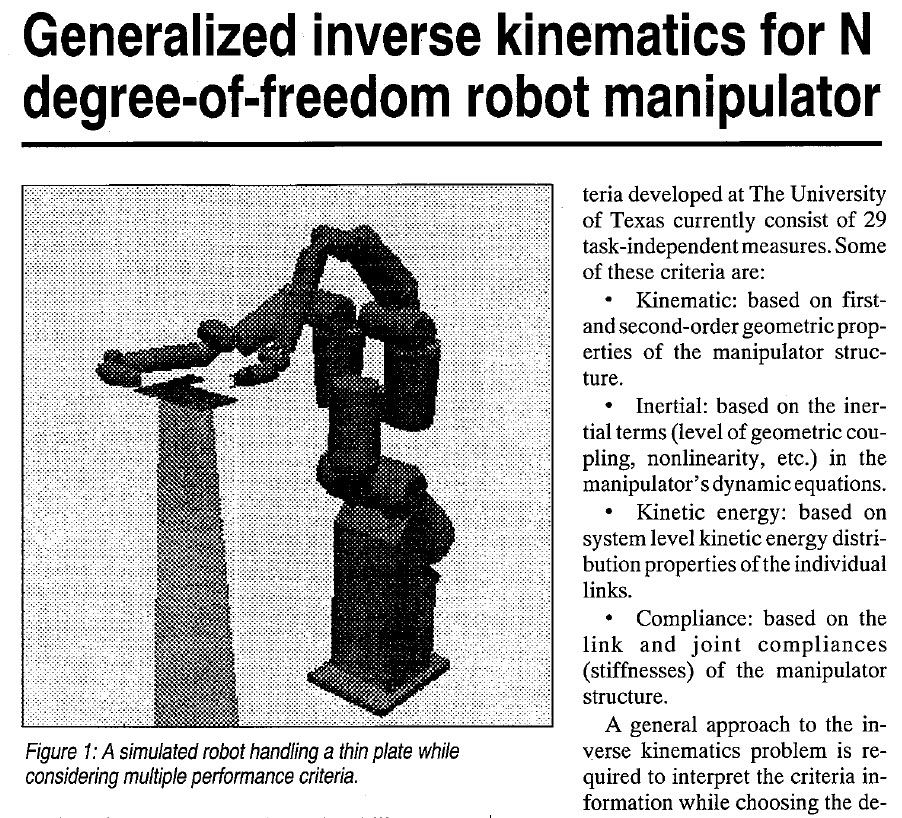
Given the model of a robot system, it is possible to define performance criteria, by which operational characteristics inherent to the robot maybe analyzed. These mathematically rigorous performance measures may be used to determine the comparative quality of specific configurations, as the criteria provide insight into the robot’s complex geometric and physical properties. The information obtained may be used to make decisions regarding the management of the robot’s resources. For example, these values give insight into characteristics such as proximity to singularities, force transmission potential, and compliance, and can be used to filter out undesirable configurations. Performance criteria developed at The University of Texas currently include 29 task-independent measures. Some of these criteria are:
• Kinematic: based on first and second-order geometric properties of the manipulator structure.
• Inertial: based on the inertial terms (level of geometric coupling, nonlinearity, etc.) in the manipulator’s dynamic equations. • Kinetic energy: based on system level kinetic energy distribution properties of the individual links.
• Compliance: based on the link and joint compliances (stiffnesses) of the manipulator structure.
A general approach to the inverse kinematics problem is required to interpret the criteria in formation while choosing the desired joint-level trajectory for the robot. The goal is to position the robot in a kinematic configuration which maximizes the performance of the task by the manipulator in real time. A general approach to the inverse kinematics problem must:
• Apply to all robotic manipulators (N degrees-of-freedom).
• Allow for the incorporation of unlimited performance criteria.
• Provide a balance between task planning requirements and manipulator performance of the task.
The approach is called “generalized inverse kinematics” since system performance criteria, as well as any other criteria (obstacle avoidance, joint limits, etc.), may be considered. By not restricting the approach to simple robot geometries, this work applies to redundant robots and hyper-redundant “snake” type robots as well as the common industrial type.
Del Tesar, Richard Hooper and Gary Browning
Robotics Research Group, Department of Mechanical Engineering, University of Texas at Austin
|