|
Chapter 2
Modularity
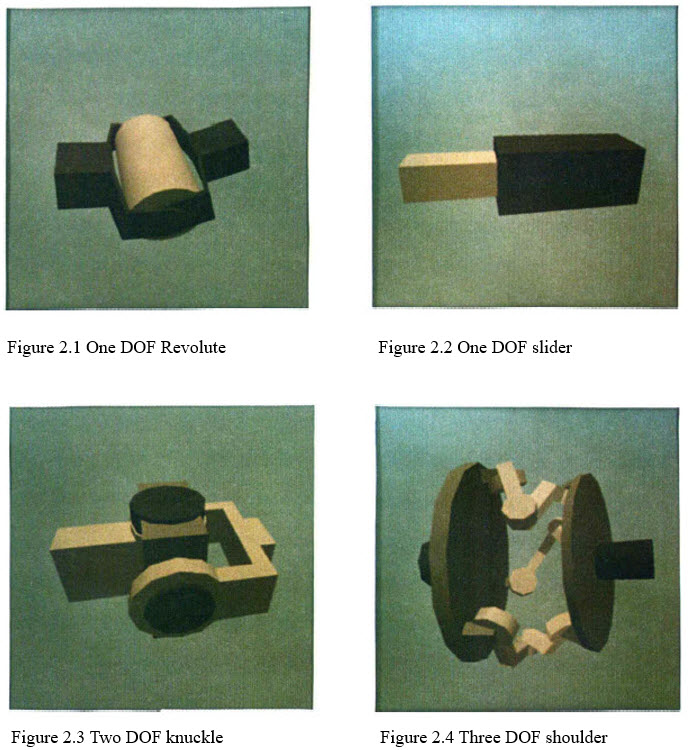
Modular design is the construction of large systems from smaller discrete units. The benefits to approaching the design of robotic systems from a modular perspective are numerous. From a finite set of one, two and three degree of freedom joint modules and generic links, a general robotic architecture can be developed. The modular robot would be reconfigurable to perform varied tasks and thus reduce obsolescence [ 46]. The design of the robot is simplified and cost can be reduced by using the same modules in a wide variety of configurations. The integration of technology is facilitated because a new robot does not have to be built in order to test a new idea. The cost of sending payload into space is tremendously expensive, thus making very attractive a robot that could perform many different tasks. Every robot that is sent into a nuclear environment immediately becomes contaminated and must be decontaminated or disposed of. This reality also makes attractive the use of a robot that can be reconfigured to perform many
tasks.
 |
There are numerous issues involved in the development of a modular and reconfigurable robotic system. The intelligence and decision making system that will deal with the inverse kinematics of a reconfigurable and possibly redundant system must be developed. A controller that can adapt to reconfiguration of the system under control must also be designed and built. Indeed modularity must be incorporated into every aspect of the robot's design in order to have a truly modular and reconfigurable system.
The creation of a computer animation system for modular and reconfigurable robots does not require that many of these issues be resolved. This has allowed the development of the modular and reconfigurable animation system to lead the development of the actual physical system by several years. The computer animation can now be used as a tool in the development of the technology necessary to realize the creation of a truly modular and reconfigurable robotic system.
A modular approach to robot design also provides many direct benefits to the computer animation of robot systems. The modular computer animation package builds graphical robots that are inherently reconfigurable to animate many different robot configurations performing a wide variety of tasks. The creation of each animation is simplified to the extent that no graphics experience at all is necessary to quickly create high quality animations. The performance of the computer animation is also increased because modularity allows many calculations to be done prior to beginning the actual animation sequence.
2.1 BENEFITS TO COMPUTER GRAPHICS
2.1.1 Reduces Obsolescence
Obsolescence is an issue that should be addressed whenever making the decision to buy equipment. Obsolescence should also be considered when making the decision to buy or write computer software. An animation package that seems fine because it has a large library of currently available robots may not be acceptable when the next generation of robots become available but are not in the library. The modular approach incorporated into the computer animation does not limit the computer animation to the current level of robot sophistication.
Current computer animation systems for robotics typically include a library of commonly available industrial robots. This has limited the application of computer animation to the current level of robot sophistication. A new model must be built every time a new robot design is to be simulated. Typically these animations are complex and require the work of a person that has experience with computer graphics. This method of producing computer animations is similar to the one-off manufacturing common in robotics [ 46]. One-off manufacturing is the design and production of expensive robots that are capable of performing only one class of task. As the task changes, the robot becomes obsolete. The same principle may be applied to the current practice of providing libraries of robot animations with computer animation packages for robotics. As new robot technology is developed and applied, the animation library becomes obsolete.
2.1.2 Simplifies Creation of Animation
Modularity greatly simplifies the creation of computer animation for robotic systems. A modular computer animation may be quickly constructed from objects that the robotics engineer is familiar with, such as links and joints. The modular approach to computer animation allows increasingly complex systems to be graphically constructed and easily used by the design engineers involved in the development of new robotic systems and technologies. This allows computer animation to be used by the designer of robotic systems in the early stages of robot development.
The current state of the art in computer graphics workstations can display very smooth three-dimensional surface animations with a lighting model, perspective and hidden surface removal. Unfortunately, generating each animation could easily require thousands of lines of computer code. This code must be written by someone who is experienced with computer graphics and adds significantly to the cost of using computer animation. Software packages that aid in the development of computer animations are available.
These software packages typically include graphical modelling primitives such as box, wedge, tube, cone and sphere, as well as transformation operations that are used to assemble the primitives into more complex models. It also must be specified where each degree of freedom is and what types of motion are possible at each joint. Although creating animations in this manner is easier than writing computer code, it can still be quite time consuming and difficult for someone who is not experienced with computer graphics. The adoption of a generalized and modular robotic architecture greatly simplifies the creation of computer animations for robotics applications. The animation is created by assembling scalable one, two and three degree of freedom joint modules and generic links into either a serial, parallel, mobile or hybrid robot configuration. The use of graphics primitives and graphics commands is not required. An animation that might require hundreds of hours writing complicated graphics code is reduced to a few minutes interactively assembling the robot from available joints and links in a modular and reconfigurable animation programming environment.
The time required to generate computer animations of robotic systems has led to the development of software applications that come with a library of available robot animations. This limits the use of computer animation to the simulation of existing robots and has hindered the application of computer animation to the early stages of robot development. A modular and reconfigurable architecture allows the designer of robotic systems to easily generate computer animations without the need for any computer graphics experience. An extremely large class of robotic systems can be animated and the motion visually evaluated by the robot designer. The animation of these designs allows experimentation with inverse kinematics routines, manual controllers and decision making schemes. The modular reconfigurable computer animation system provides the robotics engineer with the equivalent of an animated robotic testbed.
2.1.3 Increases Performance
The modular architecture facilitates an increase in the performance of the computer animation. This is because a finite number of modules are used to create a large class of robotic systems. The algorithms that define the geometry, surf ace properties and forward kinematics of each module are known. This allows many calculations to be performed and stored in fast access memory before beginning the actual animation sequence.
The graphics terminal displays a surface representation of the robot.
Mathematical algorithms may be used to define points representing vertices of polygons that lie on the surf ace of the robot. This type of surface description is called polygonal representation. A lighting model also requires that the surface normal at each vertex be calculated. An animation of a typical robot scene can require thousands of polygons. Since calculating these surface points is done in software and often requires transcendental functions, it can be seen that these calculations represent a significant overhead if they must be performed during the animation sequence. The modular robot is created from a finite set of existing modules. This allows the calculations that are necessary to generate the surface description of the robot to be performed as soon as the modules are scaled and added to the graphical robot model. The results can be stored and the calculations do not need to be repeated during the animation sequence.
The performance of the forward kinematics is also improved by the modular architecture. Each module is drawn at the current position and orientation of the local coordinate frame; the frame is then left in place for the next module. The actual translation and rotation commands which represent the joint variables are contained within each module. Translate and rotate commands, which may be implemented in hardware for significant performance advantage, can be used to move the coordinate frame and perform the translations and rotations at the joints, thus eliminating the need to perform the forward kinematics explicitly in software.
2.2 BENEFITS TO ROBOTICS
The benefits to robotics of a modular and reconfigurable architecture are many. The benefits stem from the fact that a finite set of one, two and three degree of freedom joint modules and generic links can be used to build a general mechanical architecture that represents an extremely large class of robotic systems. Robotic systems constructed from these modules will be reconfigurable to perform many different tasks thereby reducing obsolescence and lowering costs.
The design of the robotic system is also greatly simplified by the adoption of a modular architecture. This is because the design parameters can be broken down and addressed in smaller groups that are contained within each module. Input-output relations for compliance, inertia and damping can be developed for each module independently. The ability to reduce the design parameters to a manageable set also encourages the use of feed-forward design and control.
The integration of new technology is also facilitated by adopting a generalized mechanical architecture. This is because a complete new robot does not have to be built to test the application of a new technology. Less conservative design is also possible because the design is addressed at a modular level. Direct performance comparisons are also possible by changing a single module without changing the rest of the system.
Operation in environments that are hazardous to humans provides an excellent opportunity for the use of robotic systems.
Operation in space and in radioactive environments are two examples of hazardous environments that have been considered for robot application. It is, however, very difficult and expensive to place a robot in these environments. This makes a modular and reconfigurable robot that can perform varied tasks quite attractive. Because it is difficult to access a robot in space or nuclear environments, it is important that the robot be as simple to repair as possible. The repair of a modular robot can be performed by simply replacing a broken module with a working one. Fault tolerance is also a crucial issue in space and nuclear environments and can be addressed at the modular level.
2.2.1 Reconfigurable to Perform Varied Tasks
The idea that robotic systems should be reconfigurable to perform varied tasks is implicit in the generalized modular robotic architecture. In order that the robotic system be truly reconfigurable, modularity must be addressed in every aspect of the robot design. This includes the design of standardized electrical and mechanical connectors as well as the development of intelligent controllers and decision making systems that can adapt to reconfigurations of the system model. The threat of obsolescence of a modular and reconfigurable robot is reduced. The cost of producing a modular and reconfigurable robot would also be reduced in the long term.
Reduced obsolescence of production machines was seen as an early promise for robotics. Current robotics technology has failed to fulfill that promise. Today's robots are designed for a specific task, such as welding or pick and place, and the robot becomes obsolete if that task changes. A modular robot would be able to be reconfigured to adapt to changes in manufacturing demand, such as more bolt tightening and less welding. A precision task could be accomplished by using stiff er modules or perhaps the cycling time could be shortened by using lighter modules in an application that requires less precision. A modular robotic architecture would do much to fulfill the early promise of reduced obsolescence.
The development of a truly reconfigurable robot would be more expensive in the short term than producing one typical non-modular industrial robot. This is likely a contributing factor to the lack of modularity found in common industrial robots. The lack of a modular architecture can, however, be seen to be extremely expensive in the long term. The Cincinnati Milacron t3 series required seven million dollars of development expense and seven years of development time to bring to market [ 46]. The NASA space shuttle flight manipulator was delivered at a total cost of one hundred million dollars [ 46].
The next generation shuttle manipulator is expected to cost up to one billion dollars [46]. A modular mechanical architecture would significantly reduce the cost of producing robotic systems by allowing larger production runs of a finite number of modules that may be assembled into an extremely large class of robotic systems. This is analogous to the initially high cost of designing and producing microprocessors and integrated circuits that may be wired into a virtually limitless number of electronic and computer applications. This ultimately results in the enormous benefits of scale that are reflected in the price, performance and rapid advancements found in the electronics field. It is, in fact, almost impossible to imagine designing a new microprocessor for every computer application, yet robots are still designed and produced one at a time with virtually no regard to modularity or reconfigurability.
2.2.2 Improves Design Process
The design of a robot system is an extremely complex procedure in which a large group of design parameters must be considered. A six degree of freedom serial arm has eighteen geometric, fourty-two mass, thirty-six compliance and eighteen actuator parameters [46]. This is an extremely large number of design parameters and the coupling between the parameters is not intuitive or obvious. A generalized modular mechanical architecture breaks the design parameters into small manageable groups. Input/output relations can be developed for each module independently. A sufficiently complete and accurate model of the system allows the incorporation of feedforward techniques in the control of the robot.
The design of a six degree of freedom serial manipulator results in over one hundred operational parameters. Sophisticated structures incorporating redundancy, in-parallel linkages and multiple branching chains will generate far more available parameters. An intelligent and systematic design procedure would incorporate these system parameters into the design, however this number of design parameters is too large to face simultaneously. A modular mechanical architecture naturally breaks the system into functional mechanical units with a reasonable number of design parameters associated with each module.
The modular mechanical architecture allows input/output relationships to be developed for each module independently from the entire robot structure.
These input/output relations can describe dynamic phenomena such as compliance, damping and inertia that interact with the rest of the system at the mechanical and electrical connections. Engineering analysis and metrology can be used to develop the relationships that describe the dynamic behavior for each module. These input/output relations can then be used along with the configuration of the robot to determine a dynamic model for the complete system.
Typical robot control schemes use feedback from the output to the input in an attempt to cancel errors caused by system dynamics. Feedforward control implements an input algorithm that incorporates system dynamics in an attempt to cancel errors before they occur [28]. The actual performance of the feedforward control is dependent upon the completeness and accuracy of the system model. Because of the lack of modularity in current robots, accurate dynamic parameters are very difficult to determine. This impedes the use of feedforward control in the application of these robots. By adopting a modular and reconfigurable architecture, the dynamic model for any configuration would be determined by the topology of the system and the known dynamic characteristics of each module.
2.2.3 Facilitates Integration of Technology
Current robot design practice results in extremely long design-to-market cycles. The lack of a modular architecture also means that the failure of any one component within the robot will disable the entire system. This leads to
extremely conservative design that is unlikely to incorporate new less-proven technologies. It is also possible with a modular architecture to make direct performance comparisons by changing only one module and leaving the rest of the system unchanged.
The complexity of robot systems combined with the lack of a modular architecture has resulted in the extremely long design-to-market cycles characteristic in the robot industry. This is evidenced by the seven years it took Cincinnati Milacron to bring the t3 series of robots to market. This guarantees that any new technology that is integrated into the robot design is old by the time the robot comes to market. Implementation of improvements in materials, sensors, actuators or electronics will have to wait for the next robot design. A modular architecture with standardized interfaces allows the incorporation of new technology in the design of a module without requiring that the entire system be redesigned.
The high cost, both in terms of time and money, of bringing a robot system to market forces the engineer to be very conservative in the design of the robotic system. Newer and higher performance technologies must be rejected in favor of more proven technologies because the failure of a single component will disable the robot until repairs can be made and a recurring failure would jeopardize the entire robot design. A modular approach would allow less conservative design because the failure of one module would only require that the module be replaced, a repair which could be quickly performed. A recurring failure within a module would only require the redesign of that module.
A modular approach also allows direct performance comparisons between technologies. It is possible to change only one module while leaving the remainder of the system constant. In this way the effects of adding a new technology can be studied without corrupting the results by changing more than one discrete system component at a time.
2.2.4 Improves Performance in Space and Nuclear Applications
Operation in an environment that is hazardous to humans is a robotic application that would be of immediate benefit. A modular and reconfigurable robot would be of particular benefit in space and nuclear environments. It is, however, extremely expensive to send robots into these environments. The difficulty of accessing robots in these environments dictates that robots sent into space or nuclear environments must be as easy to repair as possible. These are also extremely sensitive environments where catastrophic results could occur from a robot fault. More than one billion dollars is set aside in the current space station budget for robotics and automation [ 45]. The first decommissioning of a commercial nuclear reactor in the United States cost one hundred million dollars and there are more than five hundred other reactors worldwide that will eventually follow [ 42]. This represents a tremendous opportunity for the application and further development of robot technology. A problem with sending robots into nuclear environments is that the hardware sent into the radioactive environment may become radioactive waste that must also be dealt with. The limited task capability of current robots would require that many different robots be sent into the radioactive environment in order to perform the varied tasks that would be encountered. Generating this amount of nuclear waste combined with the cluttering of the environment with robots would diminish the benefits associated with using the robots in the first place.
Experience has shown that even the most meticulously designed systems will sometimes fail. This would seem to indicate that repairability be an important consideration when designing or applying robotic systems. Repairability is of increased importance in space and nuclear applications because it is very difficult to repair a robot in these environments and it is not feasible to remove the robot from the environment in order to execute repairs. The space and nuclear environments are also likely to impose tremendous stress upon the robotic system. The stresses may come from radioactivity, wide temperature variations and orbiting debris, as well as from many other predictable and unpredictable conditions and events. A modular robotic architecture facilitates repairs because the repairs can be addressed at a modular level. Servicing could be performed by simply replacing modules. This repair could be executed by humans, by another robot or even conceivably by the robot repairing itself. Fault tolerance is of extreme importance in critical space and nuclear applications [47]. A fault in these environments could very easily have catastrophic results. Graceful degradation may not be adequate, and catastrophic failures that might jeopardize the safety of the entire system must at all costs be avoided [47]. This level of fault tolerance can be addressed at the modular level by embedding redundant actuators within the joint modules. In the event of a failure of one actuator motor, the other actuator motors could take
over and operate beyond steady-state conditions for a finite amount of time. Redundant modules incorporated into the configuration of the system as inparallel structures could also address fault tolerance at another level.
|
